



FAQs
This FAQ page gives you quick answers to the most frequently asked questions about our products and services. It helps you find important information without detours and offers clear, easy-to-follow guidance. The content is updated regularly so that you always stay up to date.
If anything is still unclear, we are of course happy to help you in person by phone at +49 8134 93020 or by email at info@delta4x4.com.
The required changes depend on the vehicle type and body (Light, Maxi, semi-integrated, fully integrated).
Light model
When fitting this tyre size, an additional wheel arch cover is required. Depending on the standard tyres, a speedometer check and, if necessary, the installation of a speedometer adjustment is required.
Maxi model
The standard wheel arch cover may be sufficient. If necessary, an additional wheel arch cover may still be required. Depending on the standard tyres, a speedometer check and, if necessary, the installation of a speedometer adjustment is required.
Fully integrated
The body parts project further beyond the standard tyres from the factory. When fitting the wheel/tyre combination, no additional widening is therefore required. Depending on the standard tyres, a speedometer check and, if necessary, the installation of a speedometer adjustment is required.
Semi-integrated
An additional widening must be fitted at the front axle. Depending on the standard tyres, a speedometer check and, if necessary, the installation of a speedometer adjustment is required.
Which sizes is the LoderTire available in? The LoderTire is available in various sizes.
What is the load capacity? At least 1,320 kg per tyre, up to 2,000 kg depending on the tyre size.
Which class is the tyre in? The LoderTire is classified in class C2 (Light Truck).
Is the LoderTire suitable for winter? Yes. The LoderTire carries the Alpine symbol (3PMSF) and is therefore fully winter-tested. In the promobil comparison (11/2024) it was also certified as having very strong performance on snow and ice.
How is the traction off the road? The aggressive sidewall profile and the tread blocks extending into the shoulder provide additional traction on loose surfaces and protect the sidewall.
Is there white lettering? Yes. The tyre has white lettering on one side.
May the LoderTire be driven all year round? Yes. Thanks to 3PMSF, the LoderTire can be used legally all year round, subject to the applicable national regulations.
On many semi- and fully integrated vehicles, the body projects far beyond the wheels from the factory. For these vehicles, delta4x4 has developed and tested solution-specific retyring options to harmonise the look while at the same time increasing ride comfort and driving safety.
If you are interested in such a solution, please contact us by email at info@delta4x4.com.
In principle, yes. We also keep all delta4x4 rims in stock as blanks. With our own CNC drilling centre, we machine the bolt circle, centre bore and offset as required. This allows us to serve (almost) any vehicle.
For individual enquiries, please email us at info@delta4x4.com.
Legally speaking, there is no legal definition of the term “new tyre”. However, the German Federal Association of Tyre Trade and Vulcanising Trade (BRV) has laid down a guideline: an unused tyre is considered new if it is no more than 3 years old. A tyre is also considered “new” if it is up to 5 years old, provided it has been stored properly and shows no changes in the material.
Mileage depends heavily on use, load, driving style, axle loads and tyre pressure. Real-world experience therefore shows a wide range.
For example, the YouTuber Sven Mammut has driven more than 100,000 km in his Fiat Ducato panel van on our Lodertire. He reports on his experience in the following video.
Note: This example is not a benchmark. It serves solely to illustrate what mileage is possible with the Lodertire.
Which standard sizes are commonly fitted? 225/75R16, 215/75R16, 205/70R15 or 215/70R15.
What does converting to 255/55R18 bring? With our 18-inch combination, lower tyre pressures can be run, depending on the axle load and approval. This reduces impacts, increases ride comfort and makes the body roll noticeably more smoothly.
The wider contact patch also provides better straight-line stability and lower sensitivity to crosswinds, especially with tall bodies.
Is the conversion permitted? Yes. We supply the conversion with a TÜV report. It is therefore approved in accordance with regulations and meets the applicable legal requirements.
Is there anything to bear in mind on the vehicle? If you drive at a lower tyre pressure than the standard, the TPMS may display a message. Your brand dealer can program the new specified tyre pressure into the system accordingly.
Yes, this is technically possible. What matters is whether this is provided for in the relevant expert report or the component type approval (TTG) for your vehicle and the lift kit used, and whether an entry in the vehicle documents can be made.
For your individual case, please contact us by email at info@delta4x4.com.
When increasing the axle load, it must be checked whether the fitted or planned wheel/tyre combination covers the increased wheel loads. It is only permissible if the rim and the tyre each meet the required load capacity per wheel.
What does Delta offer?
All Delta rims are tested for significantly higher wheel loads than are required as standard. In addition, we supply tyres with load capacities of at least 1,320 kg up to 1,450 kg per wheel (depending on the tyre size).
Note: Approval is always based on the specific axle load of your vehicle. For an individual check of your combination, please contact us by email at info@delta4x4.com.
In the registration certificate Part I (vehicle registration document).
The axle loads are listed under field 7:
7.1 = technically permissible maximum axle load, front axle
7.2 = technically permissible maximum axle load, rear axle
7.3 = additional axle, if present
Optionally also on the type plate or manufacturer’s sticker on the vehicle (often in the door frame on the driver’s side or in the engine compartment) and in the CoC certificate.
On the Fiat Ducato (camper conversion), 5.5 bar is prescribed and required at the rear axle on the standard tyres.
What effect does this have? The vehicle drives very vaguely; bumps and potholes are strongly felt.
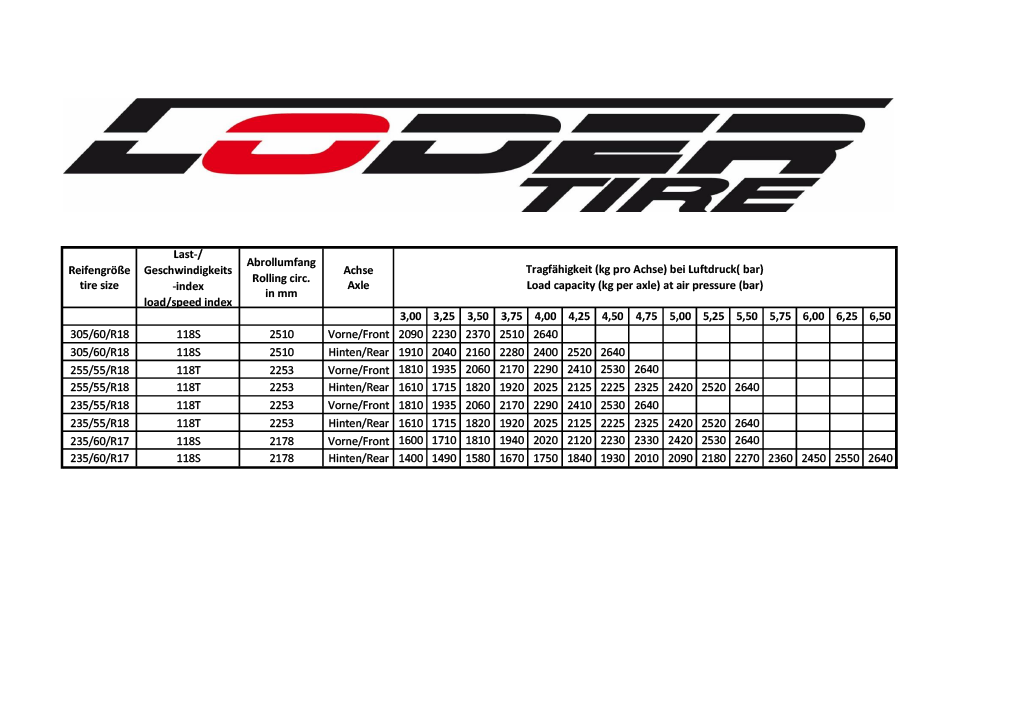
What changes with the Lodertire? By converting to the Lodertire, a lower tyre pressure can be run – depending on your axle load. You can find the axle load in your vehicle registration document in field 7.2 (see Figure 1).
Example: With a rear axle load of 2000 kg, the pressure can be reduced to 3.5 bar. This improves ride comfort and driving feel.
Why is this possible? The Lodertire is designed for high load capacities: up to 1320 kg per wheel. With 10 plies inside, the tyre allows lower pressures at 2000 kg than the original tyres. With an increased permissible weight and an axle load of 2600 kg, 5.5 bar is required.
What happens if an error message appears on the on-board display? After converting the wheels and the resulting lower tyre pressure, an error message may appear on the on-board display. In this case, go to your Fiat dealer; there the new, lower tyre pressure value can be reprogrammed in the system.
Where do I find the exact values? See Figure 2: prescribed Lodertire tyre pressures for the respective axle loads.
The blue protective layer on the white lettering (Raised White Letters, RWL for short) on tyres is a transparent protective film, based on wax or a rubber protectant, which is applied by the manufacturer.
Purpose of the layer
- Protection during transport & storage
- It prevents the white rubber compound from discolouring or getting dirty before fitting.
- Prevention of abrasion and chemical stains
- Particularly during transport or longer storage, oils, dirt or solvents could come into contact with the tyres. The blue layer acts as a barrier.
- Preserving the contrast of the white lettering
- Without this protective layer, the white letters could yellow or look greyish even before first use.
Removal
- The layer is not permanent.
- It comes off by itself through normal use, but can also be washed off before fitting with water, mild soap solution or tyre cleaner.
- Once it has been removed, the brilliant white lettering is revealed.
In short: This is not a discolouration or a defect, but a deliberate protective coating that keeps your tyres clean and looking fresh.
Here is a simple step-by-step guide to gently removing the blue protective layer from the white lettering on the tyre:
1. Preparation
- Position the tyre so that you can easily reach the white letters.
- Get hold of:
- A bucket of warm water
- Mild soap solution (e.g. washing-up liquid, no aggressive cleaner)
- A soft brush or sponge
- A microfibre or cotton cloth
2. Moistening
- Moisten the affected area with warm water.
- Apply the soap solution to the blue areas.
3. Cleaning
- Carefully brush off the blue layer with a soft brush or sponge.
- Work in circular motions until the white lettering becomes visible.
- For stubborn spots, let it soak in a little longer; do not rub too hard.
4. Rinsing
- Rinse thoroughly with clean water so that no soap residue remains.
5. Drying
- Rub dry with a microfibre or cotton cloth.
Tips:
- Avoid aggressive chemicals or solvents – these could attack the white rubber compound.
- If you like, you can then apply a silicone-free tyre care product so that the letters stay brilliant white for longer.